If your conduct, competence, personal or professional behaviour impair your ability to practise safely and effectively, you need to declare it to us.
This is set out in the standards of conduct, performance and ethics:
You must tell us as soon as possible if:
- you accept a caution from the police or you have been charged with, or found guilty of, a criminal offence;
- another organisation responsible for regulating a health or social care profession has taken action or made a finding against you; or
- you have had any restriction placed on your practice, or been suspended or dismissed by an employer, because of concerns about your conduct or competence.
(9.5)
As each matter is assessed on its unique circumstances there is no specific list of character issues which will prevent you being on the Register.
Our case studies illustrate how to apply these principles.
Different declarations for applicants and registrants
There are different requirements for character declarations depending on whether you are an applicant or a registrant.
For applicants, you must make a declaration about your character as part of your application. In this declaration you need to tell us if you have ever:
- been convicted of a criminal offence or received a police caution or conditional discharge for a criminal offence - other than a protected caution or protected conviction – in any part of the United Kingdom (these are cautions and convictions that you do not need to tell us about);
- received cautions or convictions in countries outside the United Kingdom, if the offence is one that could have resulted in a caution or conviction in England or Wales;
- been disciplined by a professional or regulatory body or your employer;
- had civil proceedings brought or any other claim against you; or
- been barred from working with vulnerable adults or children.
If you're a registrant, when you renew your registration you need to tell us:
- whether there has been any change relating to your good character that may affect your ability to practise safely and effectively.
You need to let us know as soon as possible, by making a self-referral, if:
- you accept a caution from the police or you have been charged with, or found guilty of, a criminal offence;
- another organisation responsible for regulating a health or social care profession has taken action or made a finding against you; or
- you have had any restriction placed on your practice, or been suspended or dismissed by an employer, because of concerns about your conduct or competence.
There may be other concerns that do not meet these criteria, and you may need to tell us about them to meet the standards. If you do, we will review the referral in the same way as any other self-referral or fitness to practise matter.
Telling us about convictions and cautions
-
There are some circumstances where you do not need to tell us about a caution or conviction if it is 'protected'. This varies depending on the which country within you live in the UK that you live in. You can find detailed information on this in the relevant legislation as set out below.
England and Wales: Rehabilitation of Offenders Act 1974 (Exceptions) Order 1975
Northern Ireland: Rehabilitation of Offenders (Exceptions) Order (Northern Ireland) 1979
Scotland: Rehabilitation of Offenders Act 1974 (Exclusions and Exceptions) (Scotland) Order 2013
-
When considering whether you need to declare a caution or conviction, it is important that you follow the relevant legislation for the country in the UK where the crime was committed and any guidance linked with it.
If your offence is a ‘listed offence’ under the relevant legislation of the country in the UK where the crime was committed, it will never be protected, and you must inform the HCPC immediately.
Listed offences include serious violent and sexual offences and offences which may raise concerns about whether you should work with children or vulnerable adults. You can find more guidance on listed offences and providing information about cautions and convictions on the websites of the disclosure services.
Article 22(1)(a)(iii) of the Health Professions Order, 2001 enables the HCPC to consider allegations against registrants that their fitness to practice is impaired by reason of convictions outside of the UK if they would have constituted crimes in England or Wales only and not for all countries in the UK.
We envisage that this should not significantly affect registrants practising in Scotland and Northern Ireland, as there are not significant differences in criminal law across the four nations.
However, as a UK wide regulator, our preference would be for a UK wide approach. Amending our legislation to achieve this will therefore be added to the regulatory reform agenda.
-
You must declare any cautions or convictions that you may have, even if you received them when you were under the age of 18. This includes any cautions or convictions that are considered ‘spent’ because they happened some time ago, unless they are a protected caution or protected conviction. Protected cautions or convictions are ones that you do not need to tell us about.
What doesn't need to be declared
As a general guide, no further action will usually be taken in relation to the following (except in exceptional circumstances):
- private family or personal disputes or civil matters;
- minor motoring offences such as parking fines; other fixed penalty offences; or public transport penalty fares;
- misuse of title concerns depending on the duration of misuse, frequency and seriousness of the misuse;
- matters already considered by the HCPC unless new information has been provided;
- a caution or conviction received by a person before or while undertaking a programme of study approved by the HCPC, or any other character matter, which was considered by the education provider as part of its admission procedures and the person was admitted to the programme; or was considered by the education provider under its student fitness to practise process and the person was not excluded from the programme
- disciplinary action taken by an employer which is unconnected to the practice of a relevant profession and does not relate to conduct involving violence, dishonesty, inappropriate sexual behaviour, substance abuse or the possession or supply of drugs, or conduct of a racially motivated, homophobic or similar nature.
Please note this is an indicative list and is not comprehensive.
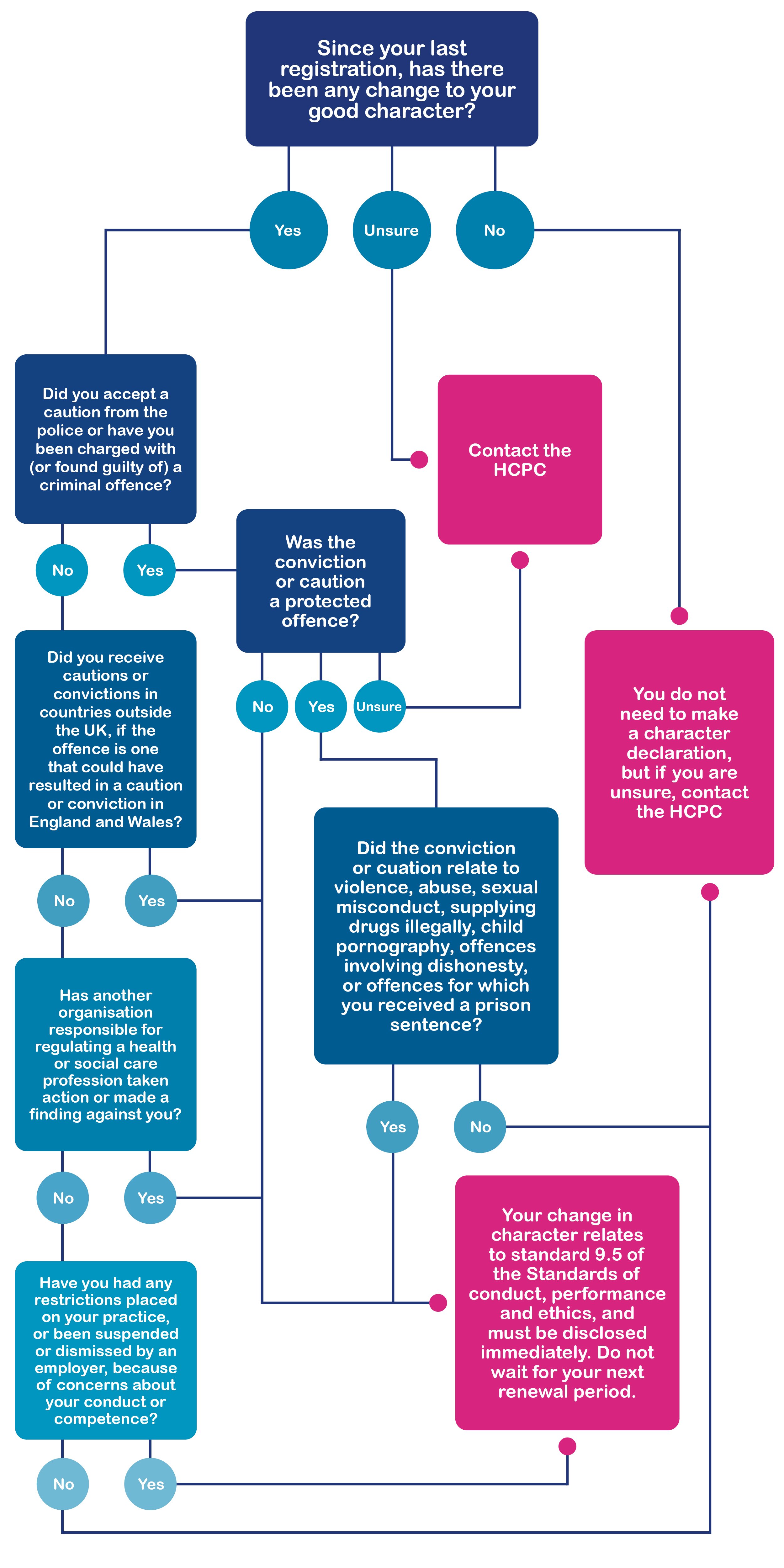
Flowchart - does my character issue need to be declared?
This flowchart shows a simplified process of assessing whether you meet standard 9.5 and if you need to make a declaration to us.